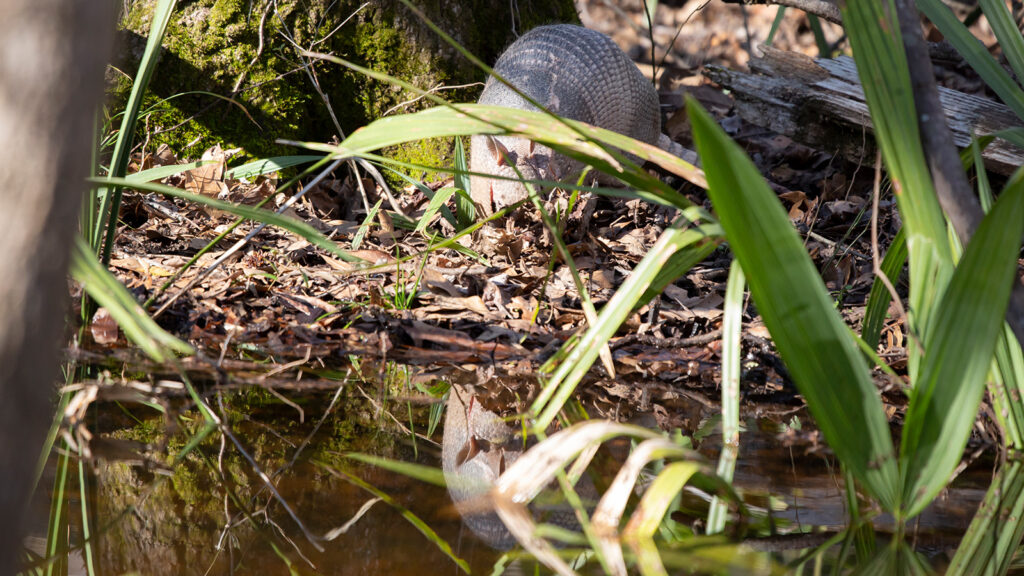
Why does Tank have two names?
“Nine-banded Armadillo” is the name many people have used for a long time. Some newer scientific lists use “Mexican Long-nosed Armadillo” because scientists learned more about how this armadillo group is related.
Tank has a hard-looking shell, a long pointed nose, digging claws, and a nighttime walk so determined that Tootie assumes he must be looking for something extremely important.
Tank is a Mexican Long-nosed Armadillo. For a long time, many people in Louisiana called animals like Tank Nine-banded Armadillos. People still use that familiar name today. But some newer scientific mammal lists now treat Tank’s group as a separate species called the Mexican Long-nosed Armadillo.
Grandma says animals do not change because scientists give them a new name. Scientists sometimes learn more by comparing bones, bodies, where animals live, and DNA. Then they may decide an animal group deserves a more exact scientific name.
One evening, Tootie sees something low and gray-brown moving along the creekside edge. They have a long tail, a pointed face, large ears, and an armored back made of hard-looking bands.
Tootie’s droopy ears lift. “Is that a tiny dinosaur?”
Yoshi’s pointy ears twitch. “No. They are digging.”
Grandma looks toward the creekside grass. “That is Tank. He is a Mexican Long-nosed Armadillo.”
Tank stops, presses his nose into the soil, and begins digging with his front claws.
Tootie watches the dirt move. “He has a shell.”
Grandma says, “He does. But he is still a mammal, like Clover, Robbie, Scott, and you.”
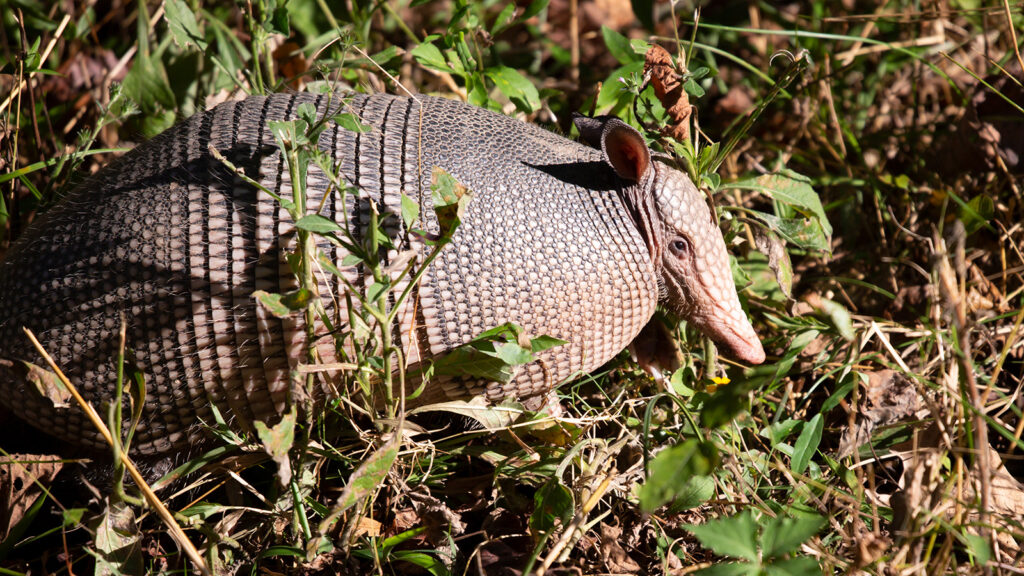
Tank’s familiar old name is Nine-banded Armadillo. That name comes from the movable bands across the middle of his shell. People may still call him that, especially in Louisiana, because they have been used for a long time.
Scientists, though, keep studying animals. They compare animals from different places and look for clues that tell them whether one group is truly the same as another group. Those clues can come from DNA, skulls, teeth, body shape, behavior, and geography.
Some mammal taxonomies now use the name Mexican Long-nosed Armadillo for Tank: Dasypus mexicanus. Older books and many people may still use Dasypus novemcinctus and Nine-banded Armadillo.
Tootie looks confused. “Did Tank get renamed?”
Grandma says, “The scientists changed the label they use for his group. Tank is still Tank.”
Yoshi watches Tank sniff the ground. “He does not care.”
Grandma smiles. “No. He has bugs to find.”
Grandma says science is allowed to get more exact. When people learn more, names sometimes change so the name matches the new information better.
Tank uses creekside edges, woods, brushy corners, low grassy places, fields, garden edges, leaf litter, and loose soil where he can dig. He needs food close to cover and soil soft enough for searching and resting.
The creek behind Grandma’s house gives Tank several useful things. The damp ground can hold worms and grubs. Fallen leaves can hide insects. The brushy edge gives him cover. The soft soil near roots and under plants gives him places to dig.
Tootie watches Tank walk slowly along the edge of the grass. “Does he live in a hole?”
Grandma says, “He may use a burrow or a sheltered spot underground, especially for resting or escaping weather.”
Tank can dig burrows with his strong claws. He may use them as a resting place, and other animals may sometimes use old armadillo burrows too.
Yoshi watches Tank disappear beneath the brush. “He needs soft ground.”
“That is right,” Grandma says. “Tank is built for digging, sniffing, and finding what is under the leaves.”
Tank is usually active at night, around dusk, or in the early morning when the yard is quieter and cooler.
Tank began life as a tiny armadillo baby in a protected underground place. Mexican Long-nosed Armadillos are famous for having four babies at one time that are usually identical quadruplets. They come from one egg that divides into four embryos.
Tootie hears this and stares at Grandma.
“Four Tank babies that all look alike?”
Grandma nods. “Usually four siblings that are very much alike.”
When the babies are born, they are small and soft. Their armor is not fully hard yet. They stay with their mother while they nurse and grow stronger.
As Tank grew, his shell hardened. His claws became better for digging. His nose became better at finding food under leaves and in soil. Eventually, he began following his mother outside the burrow and learning where to search.
Yoshi watches Tank shuffle through the creekside leaves. “Did his mother teach him where bugs are?”
“She showed him the kind of places to use,” Grandma says. “Then Tank had to learn by sniffing and digging.”
Young armadillos stay with their mother for a while, then begin living on their own. Tank is not part of a big family group like honeybees or crows. He usually spends much of his time alone.
Tank eats many small animals he finds in soil, leaf litter, rotten wood, and loose ground. He may eat ants, termites, beetles, grubs, worms, spiders, small snails, and other tiny creatures. He may also eat some fruit, eggs, or other food when he finds they.
Tank does not use his shell to smash through food. He uses his long nose to sniff, his front claws to dig, and his sticky tongue to pick up little animals.
One evening, Tank stops beside a patch of damp soil and begins digging.
Tootie watches from the porch. “He is making a hole.”
Grandma says, “He may have smelled grubs or insects underground.”
Tank pushes dirt aside with his claws, lowers his nose, and keeps searching.
Yoshi watches carefully. “He is looking under the ground like Thrash looks under leaves.”
Grandma nods. “Different animal. Same idea. Food hides in places people do not always see.”
Tank may wander through the yard slowly, nose down, checking one patch of soil after another.
Tank’s shell is made of bony plates covered by tough skin. The armor covers his back, head, tail, and much of his body, while flexible bands across his middle let him move.
Tootie sees Tank turn sideways under the porch light.
“His back looks like a road,” he says.
Grandma smiles. “Those are the bands in his armor.”
Tank’s shell helps protect him, but they do not make him invincible. He still needs to avoid cars, dogs, flooding, and people. He also has a softer underside that is not covered by armor.
Yoshi watches Tank move under a shrub. “Can he roll into a ball?”
Grandma says, “Not like some other armadillo species. Tank may curl a little, but he is more likely to run, dig, or hide.”
Tank can also move through water in surprising ways. He may walk along the bottom of shallow water or hold his breath while crossing, depending on the situation.
Tank’s long nose helps him smell food underground and under leaves. His ears help him notice sounds, and his front claws are strong enough to dig into loose soil.
Tootie watches Tank scratch at the dirt.
“His claws are like little shovels,” he says.
Grandma says, “That is exactly what they are for.”
Tank does not see as sharply as some animals, so smell is especially important. He moves slowly with his nose near the ground, checking for the scent of insects, worms, and other food.
Yoshi watches Tank stop at a patch of leaves. “He smelled something.”
“Probably,” Grandma says. “Then his claws help him get to they.”
Tank’s digging can leave little holes in lawns and gardens. Grandma knows he is not trying to make trouble. He is simply using the tools his body gave him.
Tank and Clover both use the lower parts of the yard, but they need very different food. Clover eats clover, grass, leaves, and other plants. Tank searches for insects, worms, grubs, and small animals in soil and leaf litter.
One evening, Clover is nibbling grass near the brushy edge when Tank walks past with his nose down.
Tootie watches them. “They are both looking at the ground.”
Grandma says, “But Clover is looking for green plants. Tank is looking for little animals under the ground.”
Clover hops toward the shrubs.
Tank digs near a root.
Yoshi watches both animals. “Same yard. Different dinner.”
Grandma nods. “That is why one healthy yard can support many kinds of wildlife.”
Tank sees the backyard after many birds have settled down. He may notice Robbie beginning his nighttime rounds, Bessie gliding between pecan trees, and Goldie’s web catching the last bit of evening light.
One evening, Robbie walks past Tank near the creekside brush.
“You are digging in my direction,” Robbie says.
Tank keeps digging.
“You heard me,” Robbie adds.
Tank finds a grub.
Grandma watches from the porch. “Tank has priorities.”
Tootie looks at the hole. “He found something.”
Yoshi watches Tank keep moving. “He is not stopping to explain they.”
Tank does not care about pecan arguments, bird songs, or porch gossip. He has a long nose, a patch of ground, and a whole evening of searching to do.
Grandma watches Tank from a safe distance. She does not let Tootie chase him, bark at him from close up, or try to sniff his face.
Armadillos are wild mammals. They can carry germs and parasites, and they may carry diseases that people and pets do not need to touch. Tank is not a pet, even if he looks like a small armored neighbor wandering through the yard.
Tootie watches Tank dig beside the creek grass.
“Can I follow him?”
Grandma says, “No. You can watch from here.”
“Tootie,” Yoshi adds.
“I know.”
Grandma points toward Tank. “He is looking for food. He does not need dogs, paws, or people in his business.”
If Tank gets into a place where he could be trapped or hurt, Grandma says a grown-up should contact local wildlife or animal-control professionals instead of trying to catch him by hand.
Tank needs healthy soil, leaf litter, brushy cover, and safe places to move at night. A yard with a few natural edges can support the insects and small animals he eats.
Grandma keeps pets supervised outside after dark and avoids leaving food, trash, or pet dishes outdoors. Those things can attract wildlife too close to the house.
She also checks for armadillo holes before mowing or walking through tall grass. Tank’s digging is part of how he finds food, but holes can be a tripping hazard for people.
Grandma says, “Tank can have the creekside edge and the leaf litter. He does not need to dig under the porch or turn the flower bed into a nighttime buffet.”
Yoshi watches Tank move toward the brush. “That is fair.”
Tank the Nine-banded Armadillo
These are some helpful words for talking about this wild neighbor.
Tank the Nine-banded Armadillo
Good wildlife watchers ask good questions. Here are a few to get you started.
“Nine-banded Armadillo” is the name many people have used for a long time. Some newer scientific lists use “Mexican Long-nosed Armadillo” because scientists learned more about how this armadillo group is related.
No. Tank stayed the same animal. Scientists changed the name they use to describe his group.
Tank eats insects, grubs, worms, ants, termites, spiders, and other tiny animals he finds in soil and leaf litter.
Not like some other armadillo species. Tank is more likely to run, dig, or hide.
He is searching for food or making a place to rest.
No. Tank is a wild mammal and should be watched from a distance.
They are often born as four nearly identical siblings.
Watch armadillos from a distance. Do not touch, feed, trap, or let pets chase them. Keep pet food and trash secured, supervise dogs after dark, and avoid putting hands into burrows or holes. Contact local wildlife or animal-control professionals if an armadillo is trapped, injured, or creating a safety problem near the house. Think About They: Why is giving a wild mammal space usually the safest choice?
🏅 Explorer Progress