Is Lucki an albino robin?
Grandma says:
No. Lucki is leucistic. Lucki has pale feathers, but dark eyes and normal-looking beak and legs.
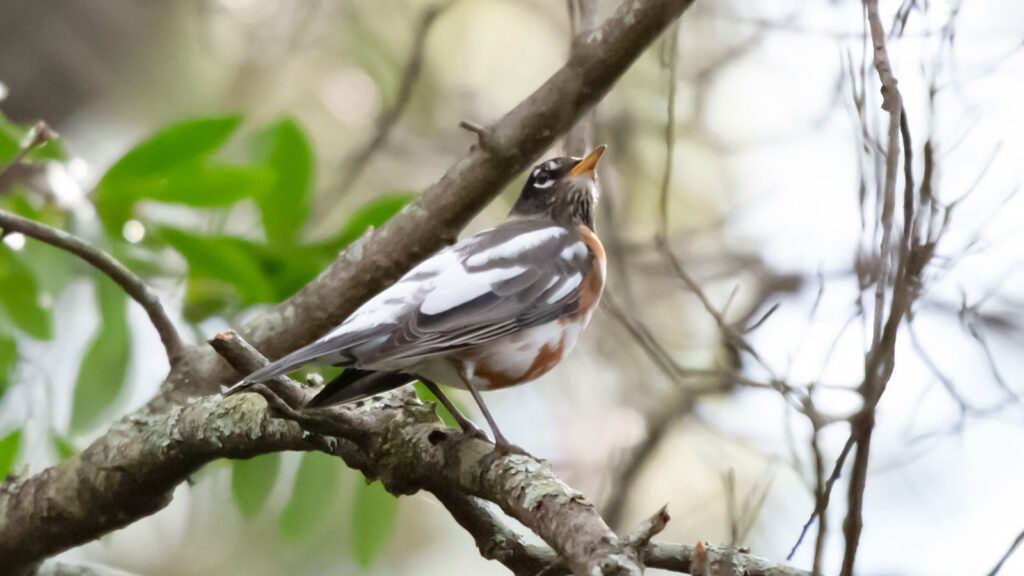
Lucki looks like an American Robin somebody painted with an extra white brush, but the pale feathers are not a costume, dirt, or a trick of the light.
Lucki is an American Robin with leucism. Say leucism like LUKE-ism. Leucism is a condition that changes how pigment shows up in feathers. That is why Lucki has unusual pale or white patches mixed with the ordinary robin colors.
Lucki still has the round robin shape, long legs, sturdy beak, and orange-red breast people recognize. But some feathers that would usually be darker brown, gray, or orange are pale white instead. Lucki’s eyes stay dark, which helps show that leucism is different from albinism.
One morning, Tootie sees Lucki hopping across the lawn near the creek.
“Why is that robin wearing snow?” he asks.
Yoshi’s pointy ears twitch. “That is a robin.”
Grandma looks closer and smiles. “That is Lucki. Lucki is leucistic.”
Tootie studies the pale feathers. “Did somebody spill paint?”
Grandma says, “No. Lucki grew those feathers that way.”
Lucki uses much of the backyard because robins need different places for different jobs. The lawn gives Lucki room to hunt worms and insects. The creekside trees and shrubs give cover from weather and places to rest. The pecan trees give high branches for singing, watching, and sometimes nesting.
Robins like open ground where they can hop, stop, and listen for food below the surface. They also use trees, shrubs, hedges, and branches for safety. Lucki may be on the lawn in the morning, in a tree by lunchtime, and tucked into a shrub when something large moves through the yard.
Tootie watches Lucki stop on the grass, tilt their head, and pull up an earthworm.
“How did Lucki know they were down there?” he asks.
Grandma says, “Robins watch, listen, and pay attention to the ground.”
Yoshi watches Lucki hop away with the worm. “That is a large lunch.”
“For a robin, they surely is,” Grandma says.
Lucki’s pale feathers may make them stand out more than an ordinary robin in some places. That means Lucki benefits from shrubs, branches, and safe places where they can rest when they need cover.
Lucki began life in a robin nest. A mother robin built a cup-shaped nest from grass, twigs, and soft plant pieces. She used mud to help hold the nest together and lined the inside with softer material.
The nest held blue eggs. Robin eggs are famous for their clear sky-blue color, and the mother kept them warm while the babies grew. When Lucki hatched, they had very little fluff, no strong flight feathers, and no way to find food alone.
Tootie hears this and looks surprised. “Lucki used to be tiny and bald?”
Grandma nods. “Most baby birds start out looking much less impressive than their parents.”
Lucki’s parents brought worms, insects, and other small food to the nest. Both parents helped feed the young. As Lucki grew, feathers came in, legs grew stronger, and wings became large enough for short flights.
After leaving the nest, Lucki still followed the adults for a while. Young robins need time to learn where worms come out after rain, how to watch for danger, and how to land on branches without crashing into leaves.
Yoshi watches Lucki hop through the grass. “They had to learn the yard.”
Grandma says, “Every young robin does.”
Lucki eats different foods in different seasons. In spring and summer, robins often eat earthworms, beetles, caterpillars, insects, and other small animals they find on the ground. In fall and winter, they may eat more berries and fruit from trees and shrubs.
That is why Lucki spends so much time on the lawn after rain. Wet soil can bring earthworms closer to the surface. Lucki listens, watches, and runs a few quick steps when something moves.
One afternoon, Tootie sees Lucki stop, tilt their head, and pull a worm from the grass.
“Did Lucki hear them?” he asks.
Grandma says, “Robins use their eyes and ears to help find food. They are very good at noticing movement.”
Yoshi watches Lucki carry the worm away. “The babies will eat that too.”
“They will,” Grandma says. “Young robins need lots of insects and worms while they grow.”
Lucki does not eat pecans like Scott or Phoenix. Lucki does not catch mosquitoes in flight like Dart. Lucki uses the ground, shrubs, and trees in different ways as the seasons change.
Leucism is why Lucki has pale or white feathers mixed into the usual robin colors. The word sounds scientific, but they means some pigment did not show up normally in the feathers as they grew.
Lucki is not an albino robin. Birds with albinism have a much bigger loss of pigment, including in the eyes. Lucki has dark eyes and a normal-looking beak and legs, even though some feathers are pale.
Tootie looks closely at Lucki’s white patch. “Does they hurt?”
Grandma shakes her head. “The feathers simply grew with less color.”
Yoshi watches Lucki move through the grass. “So Lucki is still a robin.”
“Exactly,” Grandma says. “Lucki is an American Robin with unusual feather colors.”
Lucki may be easier for people to notice because the pale patches stand out. That can make Lucki special to birdwatchers, but Grandma reminds Tootie that being unusual does not make Lucki a pet or a bird who needs people to crowd close.
Robins sing from branches, rooftops, fence lines, and other high places. Their song is often described as a cheerful series of whistles. Lucki may sing early in the morning or later in the day when the yard is quiet enough to hear.
Tootie hears Lucki from the pecan tree one morning.
“Roy is singing,” he says.
Grandma listens for a moment. “That is Lucki.”
The sound is different from Roy’s clear cardinal whistle. Lucki’s song rises and falls in a rolling set of notes, like someone talking in bird music.
Yoshi watches Lucki on the branch. “They sing from high places too.”
“Many birds do,” Grandma says. “A high branch helps a robin’s song carry across the yard.”
Lucki may sing to claim space, attract a mate, or stay in touch with another robin. The song tells other robins that somebody is already using that part of the yard.
Lucki sees the backyard from both the lawn and the trees. From the ground, Lucki notices worms, beetles, fallen berries, and Tootie’s paws coming too quickly across the grass. From a branch, Lucki sees Grandma in the garden, Yoshi under the porch shade, and Biv making another loud announcement from the pecan tree.
One morning, Scott is digging near the lawn because he thinks he buried a pecan there weeks ago. Lucki is hopping nearby, searching for worms.
Scott scratches at the grass.
Lucki pulls up a worm.
Scott looks at the worm. “That is not a pecan.”
Lucki looks at Scott. “Correct.”
Tootie laughs from the porch.
Grandma says, “Everybody is looking for something.”
Lucki does not stay in the pecan arguments for long. The grass has worms, the shrubs may have berries, and the creekside trees have safe places to sing.
Grandma likes seeing Lucki because the pale feathers make the robin easy to recognize from a distance. She watches with binoculars or from the porch instead of trying to get close.
Lucki needs the same respect as every other wild bird. Grandma does not let Tootie chase Lucki across the lawn, and she keeps cats indoors when possible. She also avoids using broad insect sprays because robins need insects and worms for food.
Tootie watches Lucki hop near the creek grass.
“Can I say hi?”
Grandma says, “From here.”
“Tootie,” Yoshi adds.
“I know.”
Grandma smiles. “Lucki can see you just fine. Let the robin decide how close is close enough.”
Lucki listens for a moment, then hops toward a shrub with a berry in their beak.
Lucki needs open ground for worms, shrubs and trees for cover, and safe places to nest. A yard with some natural leaf litter, healthy soil, berry-producing plants, and trees gives robins more chances to find food through the year.
Avoid using chemicals that can hurt insects or soak into the soil. Robins depend on the little animals that live in grass and dirt. Keep cats indoors when possible, especially during nesting season, and do not disturb nests if robins build near the house.
Grandma says, “Lucki needs worms, branches, berries, and enough quiet to raise a family. That is a much better gift than somebody trying to catch a rare bird.”
Yoshi watches Lucki disappear into the shrubs. “Lucki is not trying to be rare.”
Grandma nods. “Lucki is just trying to be a robin.”
Lucki the Leucistic Robin
These are some helpful words for talking about this wild neighbor.
Lucki the Leucistic Robin
Good wildlife watchers ask good questions. Here are a few to get you started.
No. Lucki is leucistic. Lucki has pale feathers, but dark eyes and normal-looking beak and legs.
Leucism changed how pigment showed up in some feathers as they grew.
No. Lucki is still an American Robin.
Lucki eats worms, insects, beetles, caterpillars, berries, and fruit depending on the season.
Robins use their eyes and ears to help find worms and other food near the ground.
No. Lucki is a wild bird and should be watched from a distance.
A high branch helps the song carry, and robins use songs to communicate.
Watch unusual-looking birds from a distance. Do not try to catch, feed by hand, or crowd them for photos. Keep cats indoors when possible, avoid broad insect sprays, and leave healthy soil, shrubs, and trees for robins to find food and cover. Think About They: Why can watching from farther away be kinder to a wild bird?