Why is Goldie called a golden orb spider?
Grandma says:
Her web can look golden in sunlight, and their round shape is called an orb web.
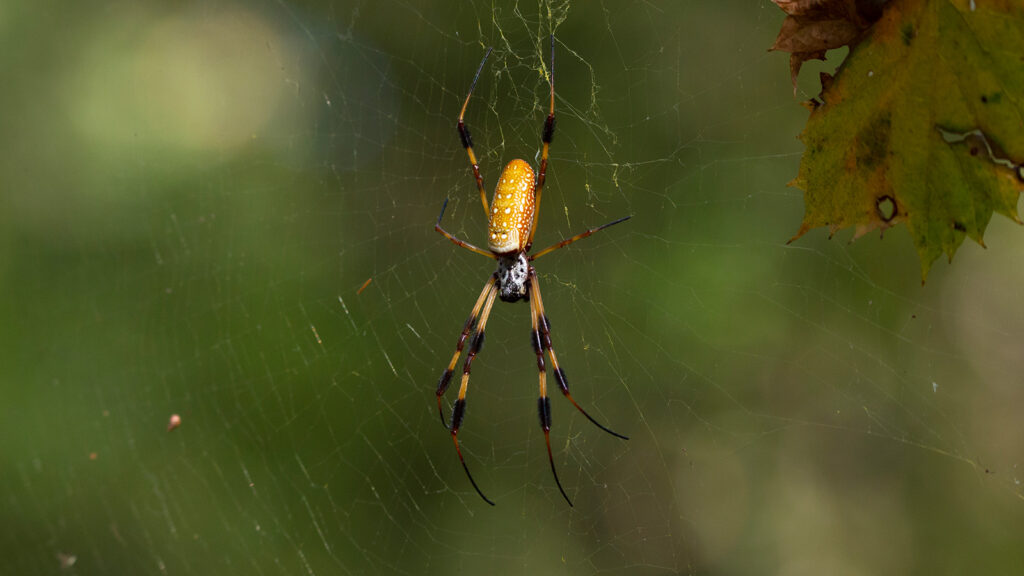
Goldie’s web catches sunlight like gold thread stretched between the creekside branches, which is beautiful until Tootie learns she built the whole thing herself.
Goldie is a Golden Silk Orb-Weaver, also called a golden orb spider. She is a large spider with a long yellow-and-brown body, long legs, and a web that can look golden when sunlight shines through they.
Goldie is female. Female golden orb-weavers are much larger than males, and the tiny males may be hard to notice near a big female’s web. Goldie does not live inside the web like a house. She sits near the center or along a silk line, waiting for a vibration to tell her that something has landed.
One afternoon, Tootie runs toward the creekside path and stops so suddenly that his front paws slide a little in the grass.
“There is a giant spider bridge,” he says.
Yoshi’s pointy ears twitch. She looks carefully between the branches. “That is a web.”
Grandma walks over slowly. “That is Goldie’s web.”
Tootie stares at the sunlight shining through they. “They are yellow.”
Grandma nods. “That is why she is called a golden orb spider.”
Goldie uses trees, shrubs, creekside branches, tall weeds, and open spaces between plants where she can stretch a large web. She needs strong places to anchor her silk and enough open air for flying insects to pass through.
The creek behind Grandma’s house gives Goldie a good web spot. Creekside plants bring mosquitoes, flies, moths, and other insects. Branches and tall stems give her places to fasten the lines that hold up her web.
Tootie looks at the web. “Does she live in the middle?”
Grandma says, “She waits there often, but the web is more like a trap than a house.”
Goldie needs the web to catch food. She cannot chase mosquitoes through the air like Dart, and she does not hop after bugs like Chirp. She builds a place where flying insects may run into her silk.
Yoshi watches the web move in the breeze. “She lets the food come to her.”
Grandma smiles. “That is Goldie’s plan.”
Goldie began life inside an egg sac. Her mother made a silk case that held hundreds of tiny eggs. The egg sac stayed in a protected place while the spiderlings developed inside.
When the eggs hatched, Goldie was a tiny spiderling. She did not look exactly like the large spider she would become, but she already had eight legs and needed to start finding food. Young spiders can spread out from the egg sac and begin making their own small webs.
Tootie looks worried. “Did Goldie’s mama teach her how to build?”
Grandma shakes her head. “Spiders do not learn web-building the way puppies learn from their mothers. Goldie’s body already knows how to make silk and use they.”
As Goldie grew, she molted. A spider has a hard outer covering, so they have to shed that covering when they gets too small. Goldie grew through several molts, becoming larger each time.
Her legs stretched longer. Her body grew. Her silk glands kept making thread. Eventually, she became the large golden orb-weaver who now has a web big enough to make Tootie stop in the middle of a run.
Goldie eats insects that become tangled in her web. Flies, mosquitoes, moths, beetles, grasshoppers, and other flying insects may hit the silk and get stuck.
When Goldie feels the web shake, she can tell that something has landed. She moves along the threads to check what they are. If they are food, she wraps the insect in silk and feeds on they.
One afternoon, a moth flies through the creekside branches and catches part of Goldie’s web.
The web vibrates.
Goldie moves.
Tootie watches from a safe distance. “She felt they.”
Grandma nods. “The web is like a message line. Every shake tells Goldie something.”
Yoshi watches Goldie reach the moth. “She knows where they are.”
“Exactly,” Grandma says. “She feels the movement through the silk.”
Goldie does not eat leaves, berries, nectar, or pecans. Her web brings her insects, and the creekside plants help because they attract many of the insects she needs.
Goldie’s web can look yellow or gold in bright sunlight. The silk themselves is strong and sticky in different places, depending on the job they needs to do.
Some strands hold the web together. Some strands catch insects. Some lines send vibrations back to Goldie when something touches the web. A web is not just a pretty shape. They are a carefully built tool.
Tootie looks at the web. “How does she know where all the strings go?”
Grandma says, “Goldie does not use a map. Her body makes silk, and her instincts help her build.”
Yoshi watches the web sway. “They have circles.”
“They have a pattern,” Grandma says. “That pattern helps Goldie catch insects and feel what is happening.”
Goldie repairs her web when wind, falling leaves, or big insects damage they. She does not simply give up when one part breaks. She checks the damage and adds more silk where they are needed.
Goldie has eight legs because she is a spider, not an insect. Insects have six legs, but spiders have eight. Goldie also has two small body sections and no antennae.
Tootie counts Goldie’s legs from the creekside path.
“One, two, three, four…”
He stops.
Yoshi says, “Eight.”
Tootie looks at her. “You counted already?”
“I watched.”
Grandma smiles. “Spiders have eight legs. That helps us tell them from insects.”
Goldie uses her legs to walk along the web, hold silk, wrap prey, and sense vibration. Her legs have tiny hairs that help her notice movement in the web and around her.
Tootie looks at Goldie’s long front legs. “She has more legs than I do.”
Grandma says, “That is why you are not borrowing her job.”
Goldie and Dart both eat flying insects near the creek, but they hunt in very different ways.
Dart flies through the air and catches mosquitoes while moving. Goldie stays with her web and waits for insects to run into the silk. Dart needs open air. Goldie needs branches, plants, and enough space to stretch her web.
One afternoon, Dart flies close to Goldie’s web, then turns away before touching they.
Tootie watches. “Did Dart almost get caught?”
Grandma says, “Dart is too quick to fly into a web on purpose.”
Goldie stays still near the center of the web.
Dart catches a gnat above the creek and flies away.
Yoshi watches both of them. “One chases. One waits.”
Grandma nods. “Both are hunters. They simply use different tools.”
Goldie knows the backyard crew by vibrations, shadows, and movement.
She feels leaves shake when a breeze comes through the creekside plants. She sees Dart flash past above the water. She notices Natalie moving through the branches. She knows Tootie is nearby long before he reaches the web, because the grass starts moving much faster.
One afternoon, Inouar lands on a branch beside Goldie’s web and begins singing.
Goldie does not answer.
Inouar sings a cardinal whistle.
Goldie does not answer.
Inouar copies Chirp.
Goldie still does not answer.
Tootie whispers, “She does not care.”
Grandma says, “Goldie is listening for web vibrations, not bird reviews.”
Yoshi watches Goldie sit still in the center. “She has work.”
Goldie catches a fly.
Inouar pauses. “Fine. That was useful.”
Grandma says, “Everybody is learning.”
Grandma likes Goldie because she catches many flying insects. She does not knock down Goldie’s web unless they blocks a walkway, doorway, or place where somebody could walk into they.
If Goldie builds too close to a path, Grandma helps everyone notice the web first. She tells Tootie and Yoshi to go around they, and she watches where she puts her hands when she is gardening near the creekside branches.
Golden orb-weavers are not aggressive toward people. Goldie would rather stay in her web than bother anyone. She may bite only if someone grabs or traps her, which is why nobody should try to pick her up.
Tootie looks at the web. “Can I touch them?”
Grandma says, “No.”
“Tootie,” Yoshi adds.
“I only asked.”
Grandma points toward Goldie. “That web is her kitchen, her warning system, and her workbench. Let her keep they.”
Goldie needs trees, shrubs, tall plants, flying insects, and quiet spots where a web can stay up. Leaving a few natural creekside branches and tall stems gives spiders more places to build.
Avoid spraying broad insect killers near the creek or garden. Goldie needs insects for food, and many other backyard animals do too. If a web is in the way, a grown-up can gently guide people and pets around they instead of destroying they right away.
Grandma says, “Goldie is not putting up a web to bother anybody. She is trying to catch mosquitoes without having to chase them all over the county.”
Yoshi watches the web shine in the sun. “That is sensible.”
Goldie the Golden Orb Spider
These are some helpful words for talking about this wild neighbor.
Goldie the Golden Orb Spider
Good wildlife watchers ask good questions. Here are a few to get you started.
Her web can look golden in sunlight, and their round shape is called an orb web.
No. Goldie is a spider. She has eight legs, while insects have six.
She eats insects that become tangled in her web, including flies, mosquitoes, moths, and beetles.
Goldie is not aggressive and would rather stay in her web. Do not touch or trap her.
Wind, leaves, and trapped insects can make the web vibrate. Goldie can feel those movements.
No. Web-building is an instinct that spiders are born ready to use.
No. Her web helps her catch food and sense what is happening nearby.
Watch spiders from a distance. Do not handle them, and teach children and pets to look before reaching into shrubs, woodpiles, or creekside plants. Golden orb-weavers are not aggressive, but any spider may bite if grabbed or trapped. Avoid broad insect sprays because spiders depend on insects for food. Think About They: Why is looking first safer than reaching into a place you cannot see clearly?