Does Grenda live in Grandma’s garden?
Grandma says:
Grenda mostly lives in the front-yard shrubs. She may visit flower beds or the garden when she is looking for insects and spiders.
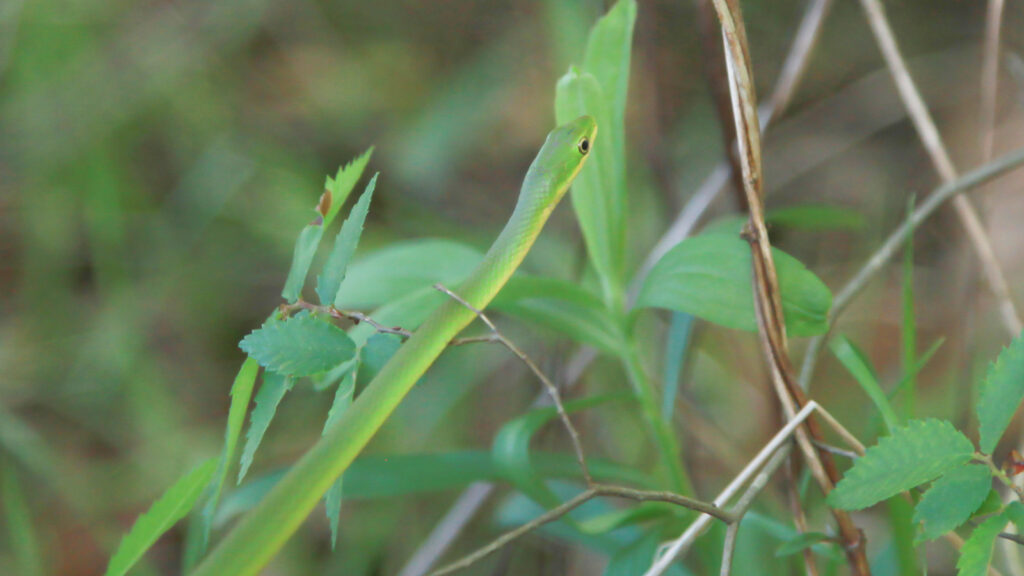
Grenda lives in Grandma’s front-yard shrubs, where leaves, branches, and shadows make a fine place for a small green snake to disappear.
Grenda is a Northern Rough Greensnake. She has a bright green body, a pale yellow belly, and tiny ridges on her scales that give her a rough-looking texture up close. Most people do not get close enough to see that part, though. Grenda spends much of her time tucked into the front-yard shrubs, where her green body blends with leaves and stems.
Tootie sees her one warm morning while Grandma is pulling a few weeds near the walk. Something moves through the shrub branches, then stops beside a leaf. Tootie’s droopy ears lift a little. He takes one curious step forward.
Yoshi’s pointy ears twitch.
Grandma says, “Leave they.”
Tootie stops.
Grenda stays still.
Tootie looks at the leaves, then at Grandma. “Where did she go?”
Grandma points to a branch right in front of him. “She is still there. Grenda just knows how to become part of the shrub.”
Tootie squints. Yoshi watches from the porch. Then Grenda slips between two branches and disappears deeper into the leaves.
Grandma smiles. “That is how a little snake stays safe. She does not need a crowd. She needs good cover.”
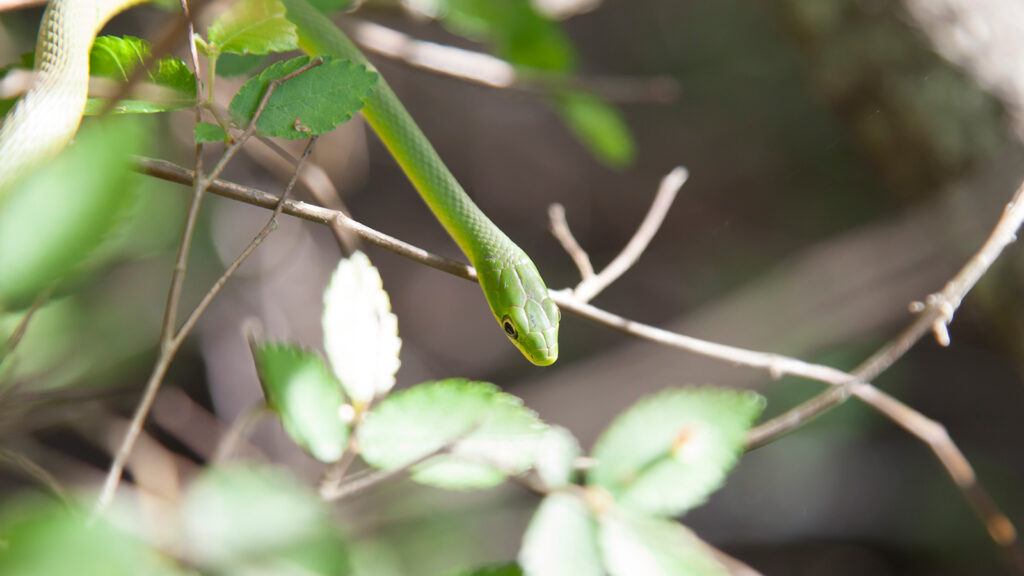
Grenda does not live in a bird nest, a dog bed, or a little house with a door. Her home is the thick front-yard shrubbery.
Shrubs give her branches to climb, leaves to hide behind, and cool spaces near the ground. They also give her food. Grasshoppers may hop onto leaves. Caterpillars may crawl along stems. Spiders may stretch webs between branches. Crickets and beetles move through the mulch below.
Grenda can travel through the shrubs without shaking the whole plant. Her body is long and thin, and her green color matches the leaves around her. A hawk flying overhead may have trouble seeing her when she stays still. A curious dog may lose track of her after one quick slide through the branches.
Grandma’s shrubs sit in the front yard, where people walk past, cars come and go, and the porch stays busy. Grenda knows when to stay hidden. She may rest in the leaves during the day, then move slowly through the branches when she is looking for food.
Tootie thinks the shrubs look like a giant hide-and-seek fort.
Grandma says, “For Grenda, they are a house, a grocery store, and a safe place all at once.”
Yoshi watches the shrubs for a moment.
Then she lies back down. She knows some neighbors prefer privacy.
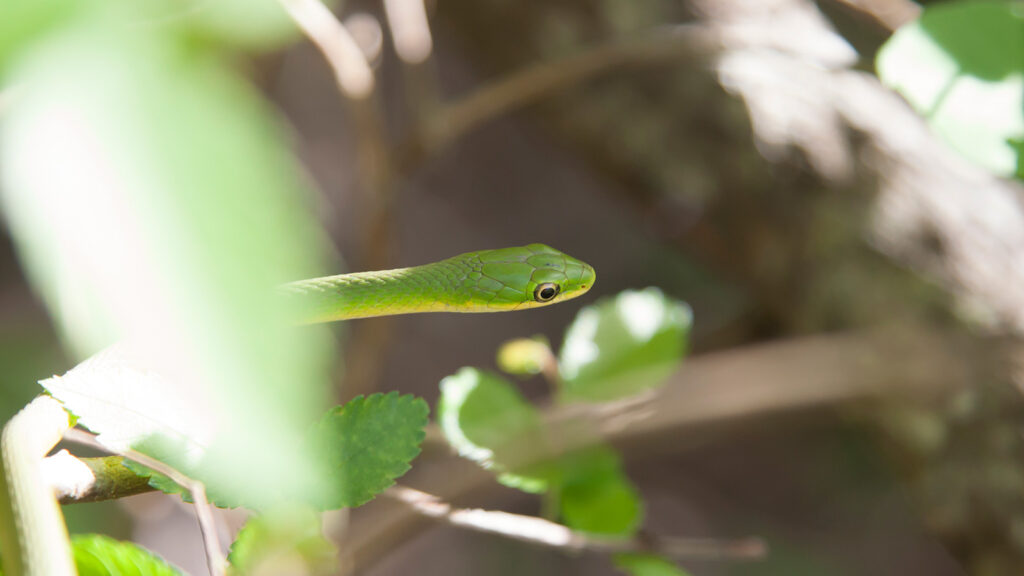
Grenda started life inside an egg. Her mother found a damp, hidden place and laid eggs where the babies could stay protected. Rough Green Snakes may lay eggs beneath leaves, in loose soil, inside soft rotting wood, or in other quiet places that hold moisture.
Later in summer, the eggs hatch. Baby green snakes come out small, thin, and ready to move through the world on their own. They do not stay in a nest while parents bring food. They have to find cover, avoid danger, and hunt tiny prey for themselves.
Tootie thinks that sounds hard.
“Her mama just leaves?” he asks.
Grandma nods. “Snake families work differently from dog families. The babies hatch ready to start making choices.”
Tootie looks toward the shrubs.
“That is a lot of choices for a baby.”
“They are,” Grandma says. “That is why Grenda needs places to hide.”
As Grenda grows, she sheds her skin. Snakes grow new skin underneath the old layer. When the old skin gets too tight, they peels away in a long, clear, papery piece.
One day, Tootie finds a shed skin near the shrubs. He wants to carry they inside.
Grandma says, “Absolutely not.”
Tootie looks offended.
Grandma says, “You already have toys. You do not need reptile laundry.”
Yoshi gives one slow tail wag.
Grenda does not eat pecans like Biv. She does not eat birdseed like Kevin. She does not chew dog food like Tootie.
She eats small animals with too many legs.
Rough Green Snakes eat insects and spiders. Grenda may hunt grasshoppers, crickets, caterpillars, moths, beetles, and spiders. The front-yard shrubs give her plenty of places to find them.
She moves quietly through the leaves, looking with her eyes and tasting the air with her tongue. Her tongue flicks in and out, picking up tiny bits of scent from the air and leaves. That helps her learn what has moved through the shrub before she gets there.
Tootie sees her tongue flick one afternoon.
“Is she licking the air?” he asks.
Grandma says, “Sort of. She is checking the smells.”
A grasshopper lands on a leaf near Grenda. She lifts her head, waits a moment, then moves quickly.
The grasshopper disappears.
Tootie stares.
Yoshi’s ears twitch.
Grandma says, “That is why she was paying attention.”
Grenda does not rush after every bug she sees. She waits until she has a good chance. Yoshi thinks that is sensible. Tootie thinks they sounds like a lot of waiting.
Grenda’s green color is camouflage. Camouflage means an animal’s colors or patterns help them blend into the place where they lives.
A bright green snake may sound easy to spot. In thick green shrubs, she can disappear beside a leaf, along a stem, or under a little patch of shade. Her body does not have loud stripes or bold spots. She looks like part of the plant until she moves.
Grandma says Grenda looks like somebody drew a leaf with a crayon and gave they a tail.
Tootie studies the shrub.
“She does have a tail.”
“Yes,” Grandma says. “That part was accurate.”
Hawks, owls, larger snakes, and other animals may hunt small snakes. Grenda stays safe by keeping still, slipping through cover, and avoiding trouble before they gets close.
She does not have venom. She does not want to fight Tootie, Yoshi, Grandma, or anybody else.
She wants space.
Grandma says, “That is a good rule for every wild animal. Watch from far away and let they handle their own business.”
The front yard gives Grenda a different view of the world.
She can hear people walking up the drive. She can feel vibrations when a car passes. She can watch birds land in the shrubs. She can smell rain before they falls and feel the leaves change as the day warms up.
Grandma checks the shrubs before she trims branches or pulls weeds. She knows Grenda may be curled inside, hidden where nobody can see her.
One afternoon, Grandma carries a small basket toward the front beds. Tootie follows close behind. Yoshi comes out more slowly and sits near the porch.
Grandma stops beside the shrubs.
“Hold up,” she says.
Tootie freezes.
A small green body loops along a branch just inside the leaves.
“Grenda,” Tootie whispers.
Grandma nods. “Yep. She is home.”
Tootie wants to say hello.
Grandma says, “You can say hello from right there. You cannot climb into her shrubs, bark at her, or invite yourself over.”
“Hi, Grenda,” Tootie says.
Grenda does not answer. She slides farther into the leaves.
Yoshi watches the shrub for a moment, then looks away.
Grandma says, “She heard you. She just has better things to do.”
Grenda mostly stays in the front-yard shrubs, but she may travel into nearby plants when she is hunting. A garden bed, flower border, or patch of tall leaves can hold insects and spiders too.
Grandma may see her near the azaleas or beside the little garden. That does not mean Grenda moved houses. They means she found food close by.
One summer afternoon, Grandma spots Grenda near the tomato plants. Tootie sees her too and starts to step forward.
Yoshi’s ears twitch.
Grandma says, “Leave they.”
Tootie stops.
“Does Grenda live in the garden now?” he asks.
Grandma shakes her head. “Nope. She lives in the shrubs. She is just out getting lunch.”
Tootie understands that. He has wandered into the kitchen plenty of times without moving his bed in there.
Yoshi gives him a look.
Tootie says, “What? That is different.”
Grandma laughs. “A little.”
Tootie has made this mistake before.
A green garden hose lies curled near the front flower bed. Grenda lies curled in the front-yard shrubs. From far away, both can look long and green.
One day, Tootie sees the hose.
“Grenda!”
Grandma says, “That is the hose.”
Tootie slows down.
A few days later, he sees Grenda in the shrub.
“Garden hose!”
Grandma closes her eyes for a second.
Yoshi sits beside her.
Grandma says, “We are going to work on your identification skills.”
A garden hose does not move by themselves. A garden hose does not have eyes. A garden hose does not flick a tiny tongue. A garden hose does not eat grasshoppers.
Grenda does all those things.
Grandma tells Tootie that they are okay not to know what something is at first. The important thing is to stop, stay back, and get a grown-up.
That rule works for snakes, spiders, mushrooms, strange plants, and anything else in the yard that makes you unsure.
Biv the Blue Jay usually notices Grenda before Tootie does. He sees movement in the shrubs and gives one sharp call from the pecan tree.
Kevin the Crow sees movement too, but Kevin watches from a branch. He knows a small snake can still bite if something grabs or scares her.
Wilson keeps working the pecan tree. He has insects to find and does not involve himself in every front-yard rumor.
Helen the Honeybee keeps visiting the flowers.
Yoshi watches from the porch.
Tootie wants to hold a meeting.
Grandma says, “Nobody needs a meeting. Grenda is in her shrubs, the dogs are on the porch, and everybody can stay happy that way.”
Tootie sits beside Yoshi.
For a minute.
Then he whispers, “Do you think Grenda knows Biv?”
Yoshi looks toward the shrubs.
Grenda is gone again.
Grandma has snake rules.
First, stop.
Second, take a few big steps back.
Third, tell a grown-up.
Do not touch the snake. Do not throw rocks. Do not poke they with a stick. Do not try to pick they up. Do not let a dog chase they.
Even a harmless snake may bite if they feels trapped or scared. People should never try to guess whether a snake is safe by getting close enough to inspect they.
Grandma says, “You can enjoy a snake without auditioning to become their problem.”
Tootie thinks that sounds fair.
Yoshi thinks they sounds wise.
Grenda would probably agree, though she would not stay around long enough to say so.
Grenda needs safe outdoor places with plants, cover, and food.
Front-yard shrubs, leafy plants, vines, and little brushy corners give her places to hide. A yard with insects and spiders gives her food.
Keep pets supervised outside. Do not use glue traps outdoors, because snakes, birds, lizards, and other animals can get stuck in them. Use fewer harmful chemicals around the yard when possible. Grenda eats insects, and poisons that hurt insects can also affect the animals that eat them.
Do not kill a snake just because you see them.
Give they room.
Let they move away.
Call a trained local wildlife professional if a snake is inside a house, trapped, injured, or somewhere they may hurt people or pets.
Grandma says, “Grenda is not asking for a bedroom. She wants to live in the shrubs and eat bugs. That seems like a manageable arrangement.”
Draw a maze with these parts:
Start: Grenda curled inside Grandma’s front-yard shrubs
Safe stops: a leafy branch, an azalea bloom, Wilson on the pecan tree, and Yoshi resting on the porch
Wrong turns: Tootie’s digging spot, a bird nest, Kevin’s snack pile, and a green garden hose
Finish: A grasshopper on a leaf near the shrub edge
Add Grandma near the walk with one hand held out toward Tootie. Add Tootie looking curious from a safe distance.
Maze caption:
Grenda smells a grasshopper near the shrubs. Help her travel through the leaves while Tootie stays back and lets her work.
Grenda the Northern Rough Greensnake
These are some helpful words for talking about this wild neighbor.
Grenda the Northern Rough Greensnake
Good wildlife watchers ask good questions. Here are a few to get you started.
Grenda mostly lives in the front-yard shrubs. She may visit flower beds or the garden when she is looking for insects and spiders.
No. Northern Rough Greensnakes are nonvenomous. Still, people should never touch a wild snake.
She would rather hide or move away. Any wild animal may bite if someone grabs or scares they, so give her space.
Her tongue helps her collect smells from the air and ground.
Her green color helps her hide in leaves, vines, grass, and shrubs.
Rough Green Snakes mostly eat insects, spiders, and other small animals without backbones.
A snake grows a new layer of skin, then sheds the old one when they gets too tight.
Stop, step back, and tell a grown-up. Never touch or chase they.
Teach children to stop, back away, and get an adult whenever they see a snake. Do not allow children or pets to touch, chase, trap, or try to identify snakes up close. Keep dense shrubs, stacked wood, and leaf piles in mind when working outside, and contact qualified local help if a snake is injured, trapped, or inside the home.